
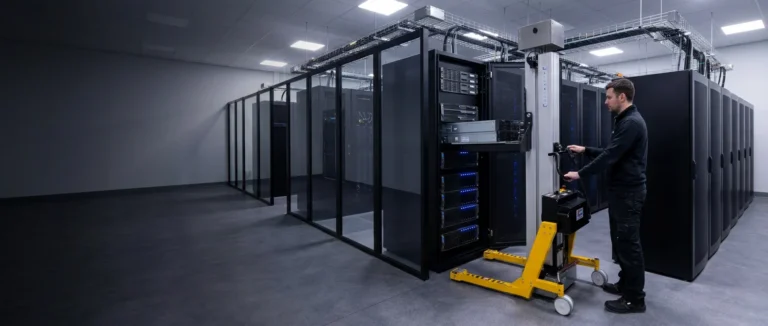
AI infrastructure is changing the handling task inside the data hall. The right response is not a generic lifting rule, but equipment selected for the actual load, rack height, aisle and maintenance procedure.
GPU-dense servers, liquid-cooling hardware, larger power supplies and high-capacity storage systems can be substantially heavier and more awkward than the equipment many data halls were originally organised around. Even when a node is within a team’s nominal manual-handling limit, its depth, centre of gravity, installation height and rail arrangement can make controlled positioning difficult.
That matters during maintenance as much as it does during an initial installation. A technician may need to withdraw a chassis from a live rack, support it while connections are checked, move it through a narrow aisle and return it to an exact rail position. The load cannot be allowed to tip, drift or rest on surrounding equipment.
The practical question: Do not select a server lifter from the weight alone. Confirm the load, centre of gravity, lowest and highest rack position, loading direction, aisle width, doorway clearance and the final positioning movement.
A conventional team lift can share weight between people, but it does not create a stable platform or provide fine vertical adjustment. As the load becomes heavier or more front-loaded, small corrections at rack height become harder to coordinate. The risk is not limited to back strain: uncontrolled movement can damage rails, connectors, fibre, flooring or the chassis itself.
A purpose-built server lifter carries the load on a stable platform and provides powered vertical movement. This lets the operator raise or lower the equipment in small, controlled increments while the brakes and directional control support accurate alignment. Depending on the model and the approved procedure, this can also reduce the number of people needed to support the weight manually.
LiftRite’s data-centre range covers compact maintenance trolleys, higher-capacity server lifters and equipment for moving complete cabinets. The correct choice depends on what is being handled rather than on a single standard model.
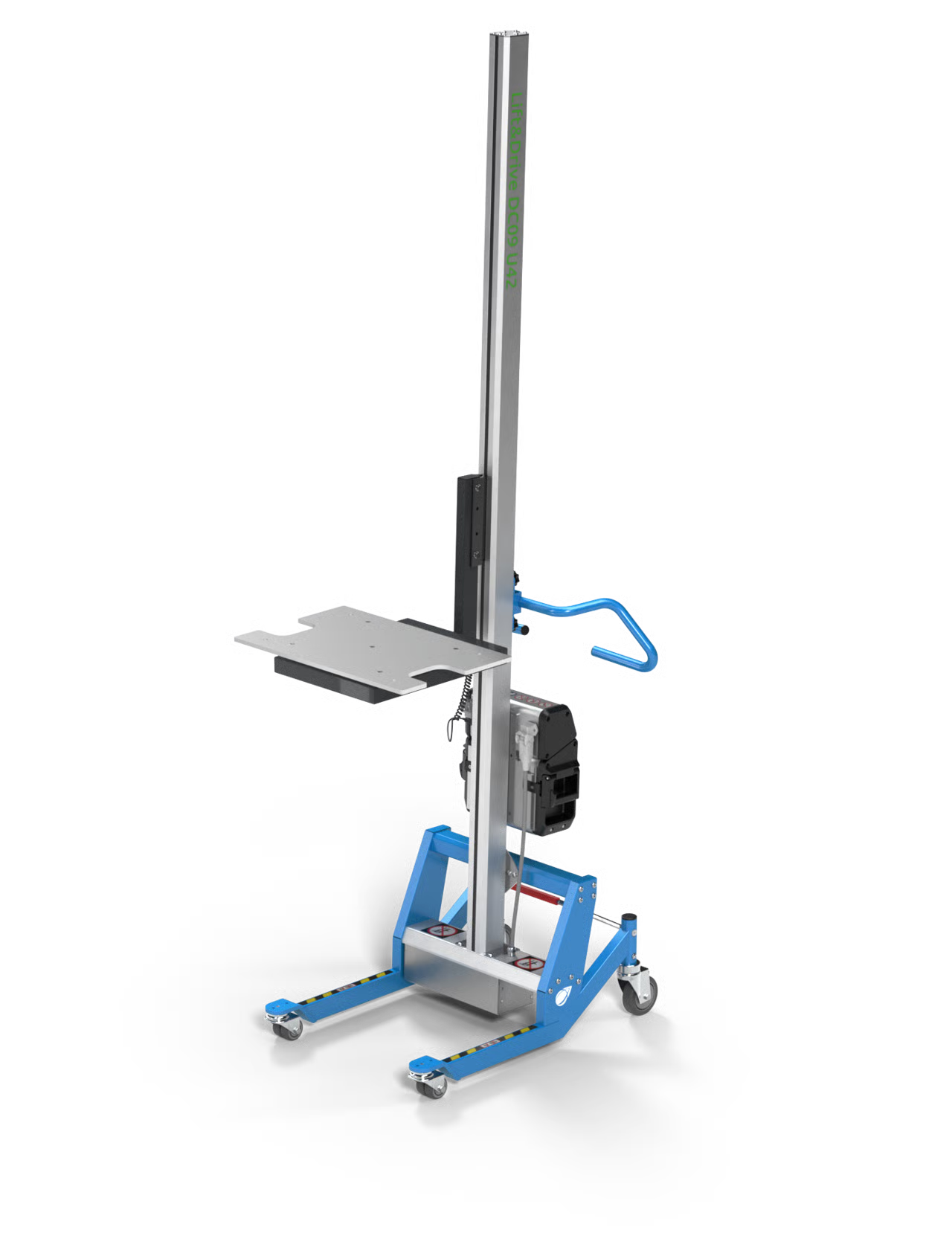
Server dimensions and access arrangements vary. Some tasks require front loading; others are safer with side loading or a platform that can shift laterally after the lifter is positioned. The platform must support the chassis correctly, leave access to the required interfaces and remain compatible with the rack rails or transfer process.
This is particularly important for long GPU chassis and liquid-cooled systems. The load’s stated mass is only one input. A risk assessment should also consider whether the centre of gravity changes as a chassis is withdrawn, whether hoses or cables constrain movement and whether drip-control or contamination procedures affect the handling method.
A server lifter is most effective when it is written into the maintenance procedure rather than treated as an accessory brought in after the task has started.
A mobile server lifter is intended to lift and position individual equipment. A fully populated rack is a different load with a much greater mass and a higher centre of gravity. LiftRite supplies powered server-cabinet tugs for loads up to 8,000 kg, giving a trained operator controlled traction for rack relocation without relying on repeated manual pushing.
Where a rack must be transferred from a shipping crate or platform, LiftRite’s server-rack ramp can be used with a motorised tug. Its self-levelling arrangement, secure latching, swivel castors and detachable handrails are designed to create a more stable loading and unloading transition.
AI hardware may be changing quickly, but the handling principle is straightforward: remove unsupported lifting wherever reasonably practicable and give the technician stable, controllable support throughout the transfer. Selecting the correct capacity, mast height and platform is more useful than relying on a generic ‘heavy-duty’ description.
LiftRite can review the equipment, rack and access route and recommend a standard or bespoke solution.