
Manual-handling training remains important, but Irish employers must first consider whether hazardous handling can be avoided or reduced through the organisation of the work and appropriate mechanical equipment.
Installing or removing a server is not a simple lift from floor to bench. The task can involve a deep and unevenly balanced chassis, a narrow hot or cold aisle, a rack position close to floor level or above shoulder height, and a need to align the load precisely with rails while protecting live infrastructure.
Good lifting technique cannot change those conditions. It cannot reduce the mass, create clearance in an aisle or provide stable support while a chassis is being aligned. This is why a server-handling procedure should start with task design and risk reduction, not with a reminder to lift carefully.
Chapter 4 of Part 2 of the Safety, Health and Welfare at Work (General Application) Regulations 2007 addresses the manual handling of loads. Regulation 69 requires an employer to take appropriate organisational measures, or use appropriate means – particularly mechanical equipment – to avoid the need for manual handling. Where manual handling cannot be avoided, the employer must assess the conditions and take measures to reduce the risk.
The Health and Safety Authority’s guidance makes the sequence clear: consider whether the activity can be eliminated or reorganised, then whether mechanical or other means can avoid or reduce the handling. Training and instruction support the control measures, but they are not a replacement for redesigning a hazardous task.
Important: This article provides general practical information, not a site-specific risk assessment or legal advice. Each employer must assess its own equipment, people, work area and procedure.
TILE – Task, Individual, Load and Environment – is a useful way to structure the assessment. It should be applied to the full movement, including removal from the rack, transport through the data hall and final positioning.
Different stages of data-centre work require different equipment. A lifter used to position an individual node is not a substitute for a powered tug designed to move a complete cabinet.
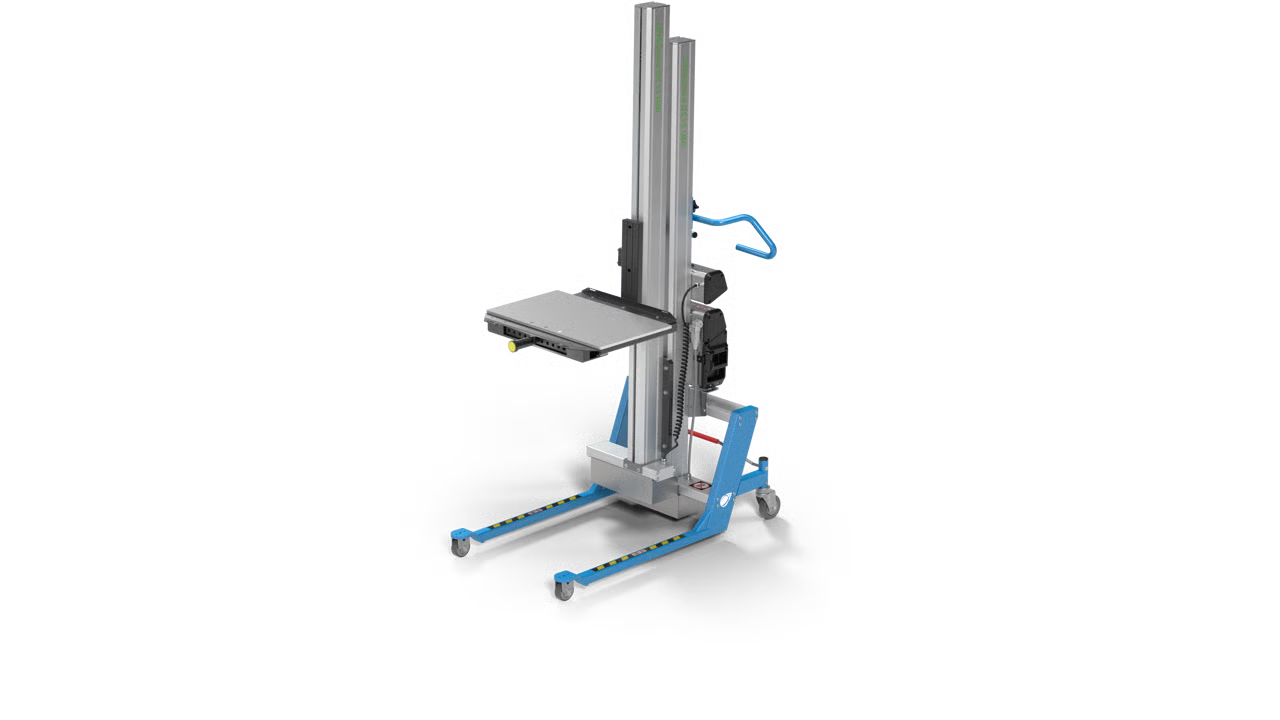
LiftRite’s compact Lift&Drive server lifters provide electric vertical movement and low rolling resistance for work in confined data halls. The 90 kg DC09 range is available with reach to 42U or 52U. The 150 kg DC15 range includes 42U and telescopic 60U versions. These models use four swivelling wheels and a central brake with directional lock to support controlled positioning.
For heavier equipment, LiftRite’s 250 kg compact server lifter includes stepless lift control and an electric side-shift platform with 150 mm movement in either direction. This gives the operator a means of correcting lateral alignment without manually dragging the chassis across the platform. LiftRite also supplies data-centre lift trolleys up to 600 kg and bespoke configurations for unusual loads or layouts.
Fully populated racks can weigh several tonnes and should be treated as a separate movement plan. LiftRite’s powered server-cabinet tugs are available for loads up to 8,000 kg. Powered traction can reduce the force required to start, stop and steer the cabinet and can make the movement more predictable for a trained operator.
Loading and unloading introduce additional risks because the cabinet may cross a level change. The LiftRite server-rack ramp is designed to work with a motorised tug and includes self-levelling, secure latching, swivel castors and detachable handrails. The proposed combination must still be checked against the actual cabinet, crate, floor and route.
Mechanical assistance only improves the task when the equipment is suitable, maintained and used under a clear procedure. A data-centre standard operating procedure should address the following points.
The objective is not simply to own a piece of lifting equipment. It is to remove or reduce unsupported manual handling and create a repeatable method for moving valuable hardware through a constrained environment. That requires the equipment, risk assessment, SOP, inspection regime and operator training to work together.
LiftRite can assess the load, rack, access route and transfer method before recommending a standard or bespoke solution.